sons of korah
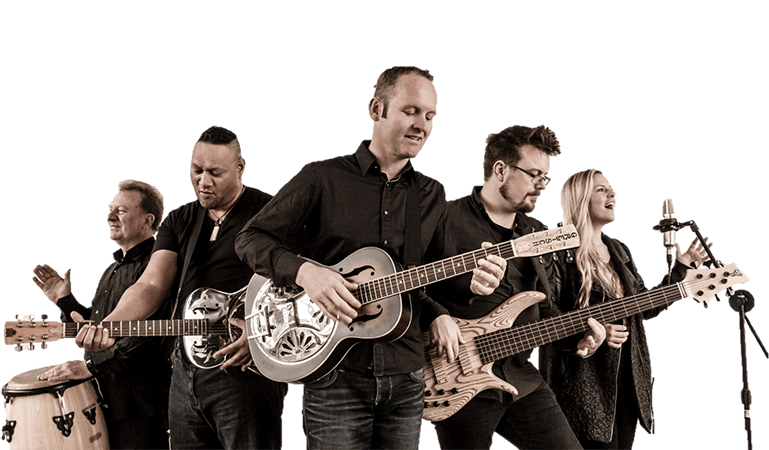
Sons of Korah is an Australian based band devoted to giving a fresh voice to the biblical psalms. The Psalms have been the primary source for the worship traditions of both Judaism and Christianity going right back to ancient times. With their unique acoustic, multi-ethnic sound Sons of Korah have given this biblical songbook a dynamic and emotive new musical expression. They endeavour to lead their listeners into an impacting encounter with this book that is often described as the 'heart' of the bible. From lamentation to songs of jubilant praise, from battle cry to benediction, from exclamation of awe and wonder to reflections of tranquillity and perfect wisdom, Sons of Korah provide a compelling portrait of the world and experience of the psalms.
Sons of Korah believe that the psalms contain a particularly pertinent message for today. They are the supreme biblical portrayal of the spiritual life in all its facets and dynamics. They speak powerfully to a postmodern world that is generally more interested in what the biblical faith looks like from the inside than its abstract doctrinal expression. And for the church today the psalms present a deep and rich spiritual well for prayer and worship. The psalms were originally written as songs and they were intended to be expressed musically. The best way to meditate on God's word is to use music and indeed this was one of dominant original purposes of the psalms. Sons of Korah invite their listeners to discover, through their music, the way in which the psalms can impact our lives today.
Matthew Jacoby
Matthew Jacoby is the leading member of the band. He co-writes the music, plays guitar and resonator and sings lead vocals. Matthew has a doctorate in philosophy/theology from the University of Melbourne, Australia. He teaches often on the spirituality of the psalms and his concise commentaries on the settings of the psalms is a feature that is woven through most concert events.www.matthewjacoby.com
Rod Gear
Rod Gear, together with Matthew is a founding member of the band and continues to also co-write the music. Rod tours with band only very occasionally being mainly involved in the writing and recording aspects of the project. Rod is a multi-instrumentalist with a mostly jazz orientated background and plays, amongst many others, the guitar, bass, cello, mandolin, resonator, piano . . .Mike Avery
Mike Avery plays the fretless bass and keys. He is also the Sons of Korah studio engineer and leading producer. Mike has also been involved in a number of other projects including producing the Unofficial Soundtack – Book of Romans a contemporary electronic soundtrack and unique listening experience.www.unofficialsoundtrack.net
Bruce Walker
Bruce Walker is the (kiwi) lead guitarist and multi-instrumentalist with Sons of Korah. His wide range of musical styles brings a unique flavour to the groups live performances. He has years of experience touring and recording with numerous Christian artists and has also toured with the New Zealand Symphony Youth Orchestra in his early years. Bruce and his wife (Tangi) are the Music Directors for three churches and teach a wide array of instruments.Rod Wilson
Rod Wilson plays drums and percussion and although he has been a professional musician for over 30 years playing in many bands of various styles, considers playing in Sons of Korah as his greatest honour and achievement. Playing and recording with many local and international artists, Rod has a broad music palate with which to contribute to the music of Sons of Korah.Ann-Maree Keefe
Ann-Maree is an acclaimed song writer with a large body of work including her solo material, worship songs for the wider church and even kids songs. She has also led church music teams, producing a benefit album ‘Revealing Your Love’ partnering with other artists to raise funds for the ‘Heal Africa’ and ‘Foundation 61’. Ann-Maree has been singing backing vocals with Sons of Korah for the last seven years.www.annmareekeefe.com
About the name
The name “Sons of Korah” comes from a group of Old Testament Levitical musicians to whom at least 13 of the Psalms are attributed. The original Sons of Korah were responsible for the ministry of music and song in the Old Testament worship and particularly with the musical composition and performance of the psalms. What follows is the remarkable story of this family according to the brief records of the Bible.
The Story of the Sons of Korah is a wonderful story of God's grace. In the Old Testament text of the Psalms reference is made to those who were involved in the composition of the psalms. Psalms 42 to 49 as well as Psalms 84 to 88 are attributed to a group known as the "Sons of Korah" (see the small print titles under the numbers of the psalms). It appears that this family of musicians were descendants of the same Korah who led a rebellion against Moses in the desert (Numbers 16). This was a serious crime that led to serious consequences for all those involved. We read that God caused the ground to open up and swallow all those who were involved in the rebellion along with their families (vs31ff). The idea of a judgement like this that involved the wiping out of the rebels as well as their families was that the line of the rebellious should not continue in the earth. It is therefore quite surprising that in Numbers 26:11 we read the words: "The line of Korah, however, did not die out." And sure enough as we follow the genealogies through Chronicles we see that that the line of Korah did indeed continue. According to 1Chronicles 6:31ff, David, when he was organising the different tasks for the temple worship, assigned the ministry of song for a large part to the Kohathites. The head of this group was Heman who is the writer of Psalm 88 and more significantly is a direct descendant of Korah the Kohathite. Hence the psalm is also attributed to the Sons of Korah. It seems that at some point this musical family came to be called after their rebellious forefather. Korah was an infamous historical figure in the Israelite consciousness, remembered as an example of rebellion against God. To be related to him would have been a notable thing, though not necessarily a negative thing. The continuing existence of this family line was a testimony to the grace of God who, although he would be right to wipe out the memory of sinful men from the earth, is nevertheless forgiving and whose heart is always for restoration and redemption rather than for destruction. The Sons of Korah were therefore a living testimony to God's grace. They certainly had much to sing about. We feel the same way.
It is a very raw and energetic album with a dynamic mix of psalms from the turbulent battle cry of Psalm 56 with its concluding triumphant anthem from which the album title is taken to the moving reflective lament of Psalm 6. The album was recorded analogue on reel-to-reel largely live in the studio so it is has a very vibrant sound to it. It begins with a bowed double bass solo and ends with a ballad called “It’s over now” based on Paul’s words in his second letter to Timothy. Apart from this song the whole album is of course devoted to the psalms including Psalms 56, 116, 93, 15, 6, 59 and some sections of 103.
Light of life set the tone for both the Sons of Korah sound and the focus of the project. The first release of albums were packaged with a booklet of reflections on the different genres of the psalms. The music is acoustic but full with lots of instrumental flavouring. The songs are vocally driven and emotive giving a very passionate voice to the words of the psalmists. The compositions are often out-of-the-box structured in sections and oriented around the text.
Redemption Songs is a diverse and dynamic album that covers a range of different genres of psalms, some intense and turbulent and others peaceful and reflective. It retains a very organic acoustic sound undergirded by the mournful tones of the double bass. It was on Redemption Songs that Sons of Korah began to feature more of the blended multi-ethnic elements including the haunting Arabic flavoured sound that has become characteristic of the Sons of Korah style. The instrumental palette on this album is broad giving richer and more dynamic expression to the various psalms. The album is richly melodic but restrained in its production which gives it alot of sensitivity and soul. The Album includes Psalms 137, 63, 121, 117, 24, 32, 148, 40, 130 and 126.
The album was made in the wake of a two year period in which Matt Jacoby and Rod Gear were playing most gigs as a duo without the full band and the album reflects the mellower performance that characterised that period. There is hardly any drums on this album and when the drum kit does appear it is only to create some dynamics. On Shelter Sons of Korah give heartfelt expression to some of the most beautiful moments in the psalms with sensitivity and feeling. Shelter has a very peaceful feel to it. It is one to listen to with headphones somewhere on your own. It includes Psalms 35, 1, 37 (in two parts), 127, 30, 73, 123, 128 and 51.
One of the differences with this album is that it was produced by a different partnership. All of the other albums before and after this have been produced by Matt Jacoby and Rod Gear who also share the song writing. Rod was absent for this one working on his solo instrumental album, Barak. Jayden had joined the band a year earlier and now collaborated with Matt to produce Resurrection. He also wrote half the material on the album. The result is something fresh and new for the band. The jubilant psalm 95 was an immediate favourite with listeners as was the catchy nylon string led Psalm 17. The album also includes Psalms 125, 69, 52, 67, 147, 80, 131, and 65. It also includes two instrumental tracks called Selah #1 and #2 respectively.
It is an intricately produced album and far more musically rich than any of the others with layers of subtle intertwining melodic content creating an intriguing listening experience. Because of this too it is an album that grows on the listener with each listen. For all its complexity however Rain, in the most part, retains the reflective disposition of the other albums but with greater dynamics than before. Spike introduced some subtle electronic soundtrack style elements to this album giving it extra drama and depth which was needed for a couple of the imprecatory Psalm adaptations. This has been Sons of Korah’s highest budget album to date and one that is packed full of highlights. It includes two popular favourites, Psalm 139 and Psalm 84 together with psalms 99, 42 (in two parts), 114, 14 (in two parts), the first part of Psalm 103 and the second half of Psalm 116.
Sons of Korah recorded Wait in their own studio space and were therefore able to relax much more in the process. This is reflected in the feel of the album. There is great attention to detail here and yet again the instrumentation is rich and melodically soothing. It is also a restrained production that feels spacious with nothing wasted. The album features a wide range of acoustic instrumentation including resonator, mandolin, oboe and the Indian harmonium. There are some longer psalms on this album that have been composed in sections that are continuous with each other but otherwise unique. Psalm 27, one of the most well loved of all the psalms, takes up four tracks on the album and the dramatic lament-to-praise epic, Psalm 77, takes up three tracks. The other tracks are Psalms 19 (in two parts), 96, 91, and a reflective response to psalms 96 and 27 called ‘Wait.’ There are some beautiful moments on this album. It is an album for hungry hearts to feed on. And that of course is the point of it all.
Inevitably the various Psalms recorded on each of the albums evolve as they are played by the band year after year and that evolution is captured on this album. Many of the psalms feature richer arrangements which will be a refreshing alternative to those who are already familiar with the studio material. There is something about the live performance that cannot be reproduced in the studio and this album captures some of the best live moments of half a decade. The title suggests that it won’t be the last Live album that Sons of Korah will release and already since then the band has been collecting some great live recordings for another volume which they will release some time in the years to come.
This CD is packaged with our full length LIVE DVD filmed in Victoria in 2006 which contains the following Psalms: 125, 121, 32, 14, 123, 73, 93, 128, 148, 137, 80, 95, 17, 126, 117, 147b and 130
The concert features a range of material, mostly from Rain and Wait. There is lots of interesting instrumental action on this recording which was made before a packed house of very enthusiastic listeners. Extras on the DVD include an interview with Matt Jacoby and a behind the scenes footage of the band’s 2009 Californian tour.
The DVD in its first pressing was packaged as part of a limited edition hardcover memento book that tells the Sons of Korah story from the beginning and features pages of full colour photos of the bands journey since the mid-nineties.
Psalm 45: A Noble Theme
Holy Holy Holy
Psalm 56: Light of Life
Psalm 116: I Love the Lord for he Heard Me
Psalm 93: The Seas Have Lifted Up
Psalm 15: Who May Dwell in Your Sanctuary
Psalm 103: Praise the Lord O My Soul
Psalm 117: All You Peoples, All You Nations
Psalm 121: He Watches Over You
Psalm 24: Lift Up Your Heads
Psalm 32: Forgiven
Psalm 148: Sun, Moon and Stars
Psalm 126: Men Who Dream
Psalm 35: Contend
Psalm 1: Blessed is the Man
Psalm 37(I): Shine Like the Dawn
Psalm 127: Unless The Lord Builds the House
Psalm 37(II): Be Still Before the Lord
Psalm 51: A Broken Spirit and a Contrite Heart
Psalm 69: Looking for
Psalm 95: Come Let us
Psalm 147b: The Lord’s
Psalm 80: Restore
Psalm 17: Apple of Your
About the Psalms
All the Levites who were musicians–Asaph, Heman, Jeduthun and their sons and relatives–stood on the east side of the altar, dressed in fine linen and playing cymbals, harps and lyres. They were accompanied by 120 priests sounding trumpets. The trumpeters and singers joined in unison, as with one voice, to give praise and thanks to the LORD. Accompanied by trumpets, cymbals and other instruments, they raised their voices in praise to the LORD and sang: He is good; his love endures forever." Then the temple of the LORD was filled with a cloud, and the priests could not perform their service because of the cloud, for the glory of the LORD filled the temple of God (2 Chron. 5:12-14).
It is impossible to say how the original psalms would have sounded and what sort of music was used. They may have sounded much more akin to Arabic music than to any western form. What is certain however is that instruments were fully utilised to express the psalms as they were intended to be expressed. The dominant musical aspect was of course the human voice and the instruments were present simply to facilitate the vocal renditions of the psalms. In fact the instruments were generally seen as optional while the singing of psalms itself was a vital part of worship in both Old and New Testament worship. In the synagogue worship that emerged from the period of the exile the psalms were sung unaccompanied. This would have been the way that psalms were sung in the time of Jesus and also most probably in the early church.
Terminology
Fierce men, bloodthirsty men, mortal man: When the psalms speak about ‘men’ in this way in the battle psalms they speak about those who are being used by the ultimate foe, the devil, to achieve his evil purposes.
Nations, foreigners: The nations that the psalms speak about in this way are those entities which are being used by Satan to crush God’s people. Hence ultimately we may understand ‘nations’ spiritually as “principalities & powers of this dark world” and “the spiritual forces of evil in the heavenly realms” (Eph.6:12).
The land of the living: This refers in the immediate sense simply to physical life but we can take the concept deeper and apply it to spiritual and therefore eternal life. Hence the land of the living can refer ultimately to heaven.
Statutes, decrees, law: For most of the Old Testament period the scriptures consisted of only five books known as the Torah, which means law. Hence when the psalms speak about law, decrees, statutes, they are simply referring to the revealed will of God: the word of God. We can therefore now take these terms to indicate the scriptures as a whole, both Old and New Testaments.
Holy Hill, Zion, Jerusalem, Temple, Sanctuary: The place where God is worshipped and where he is present in a special and favourable sense. This can apply now to any church gathering. The ultimate anti-type for these terms however is the New Jerusalem – heaven.
Death, the grave: When the psalmist speaks of death or the grave (as something from which he asks God to deliver him) we may, for broader application, think of spiritual death. Spiritual death is separation from God.
Horn: Many psalms speak about God exalting the horn of his people. A horn in the mind of the psalmists was a symbol of strength. The horns of animals are the power and chief weapon of the animal in times of conflict.
Harvest, grain, flocks: The blessings of God given to his people in the form of material prosperity. For the New Testament saint these material blessings are symbols of the greater spiritual blessings that are given through Christ. Our harvest today is a spiritual one, our grain is spiritual food and our wealth is in the gifts given by God’s Spirit.
The king, the anointed one: Many psalms refer to or are spoken by one who refers to himself as the king or the ‘Lord’s anointed.’ This is the king who sits on the throne of Israel which is a representative of the throne of God. Hence the office of king in the ultimate sense refers to the Messianic office which is eternally filled by Christ.
Place names: Moab, Negev, Edom, Babylon, etc: The significance of place names in the psalms has to do with what these places represent for the people of God in view of the history of God’s people. Each place represents a significant event or events in covenant history or a significant relation effecting the life of God’s people in the past.
Offerings, sacrifices bulls, goats, Etc: The means given by God to his people to facilitate a vivid demonstration of central aspects of the religious life – atonement, worship and thanksgiving. The physical animals and produce that were used for the offerings were signs of spiritual realities. Guilt offerings were a sign of God’s provision for the expiation of sin and the thank offerings were a sign of the giving over of a person’s life in gratitude to God.
Dogs, Lions, Oxen: metaphors used to portray malicious and powerful enemies.